Reboot
Overview
A service design project in collaboration with Getliņi EKO — research, concept development, and service design to close the gap between people who care about waste and the systems that should make it easy to act.
I was involved across all phases of the project. In the research phase I was one of the core contributors to stakeholder interviews and ethnographic research, investigating the problem from multiple angles. During ideation I drove deep research into idea generation and concept development, facilitated co-creation workshops with stakeholders, and helped shape the overall system architecture of the solution. I built the digital platform prototype using Figma AI mockups and contributed to the visual delivery of the final concept.
Categories
End to end service design process
Waste management
Client
Getlini Eko
Duration
12 weeks


Challenge
People in Latvia want to reduce waste but the systems around them make it easier to throw things away than to repair or exchange them.
Latvia needs to cut waste going to landfill from over 90% to 10% by 2030. Getliņi EKO, one of the largest waste management facilities in the country, was building a new education centre. The brief was to design an exchange and repair space people would actually use. The harder question was why they were not using the ones that already existed.
Approach
What we found changed how we framed the entire problem.
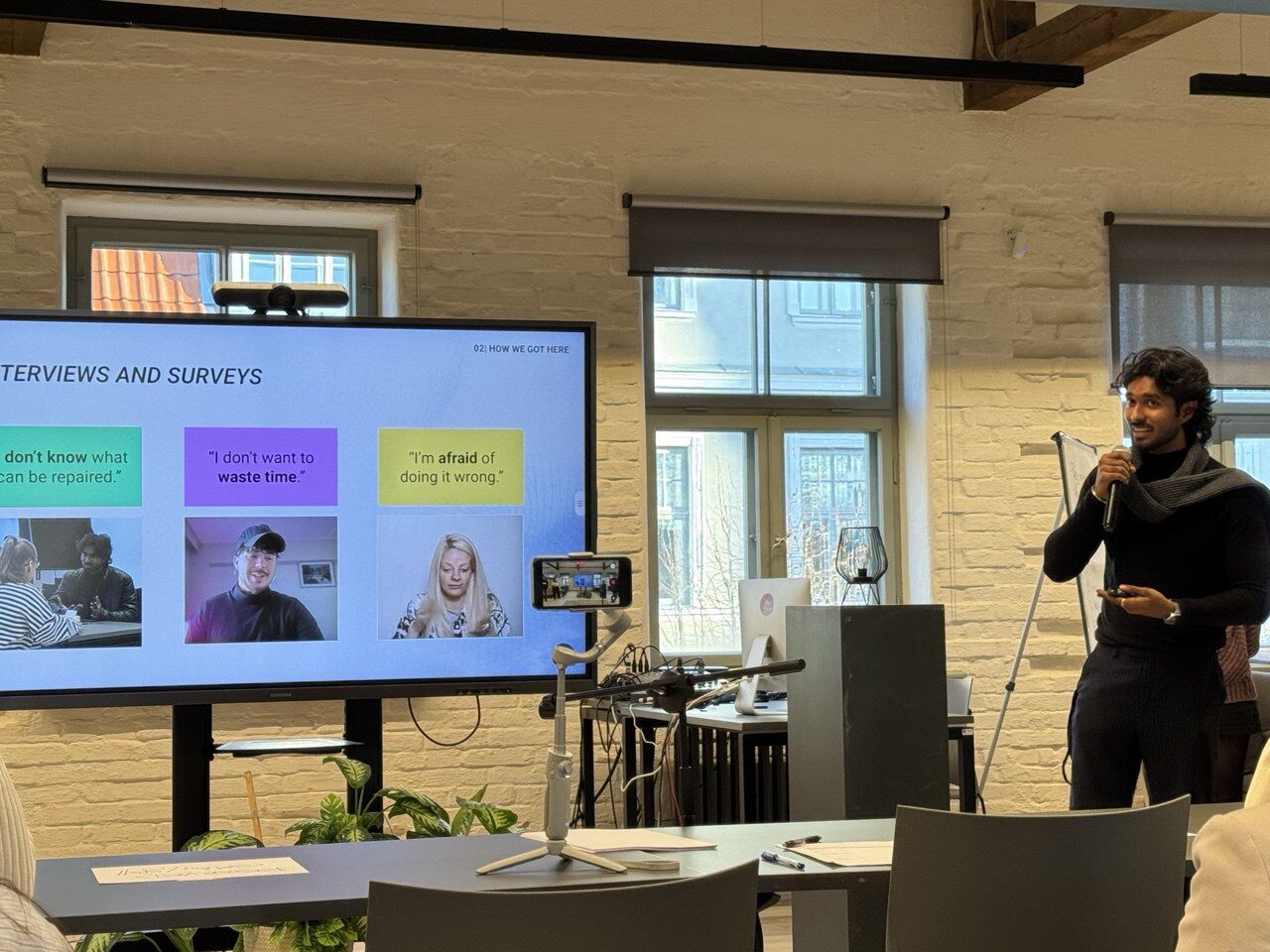
We began with a broad exploration of how Riga residents relate to the things they own, interviewing residents and commuters, observing behaviour in everyday settings, and surveying a wider group across Latvia, alongside desk research into circular economy projects elsewhere in Europe. There were some core questions we needed answers for,
The willingness of people to repair / exchange items instead of throwing them
How to encourage people who are not interested in sorting/recycling to do more?
The skills people are willing to learn & share about fixing things, the environment, etc. (the ways people want to contribute to their learning)The willingness of people to let go of things they are no longer using.
How Might We
How might we create a hybrid ecosystem that gives people a physically interactive and emotionally engaging way to rethink the value of the things they own.
Solution
Rather than designing a single service, we designed a layered ecosystem where each part addresses a different moment in someone’s relationship to an object, from the decision to let go of it, to the journey of giving it away, to what happens to it next.
Through the co-creation workshop and research synthesis, we identified three points where the existing system was most broken and most open to change: the distance people had to travel, the uncertainty about what was even allowed, and the emotional weight of throwing something away with no story attached to it.


Outcome
80%
of prototype testers said storytelling or community features would make them return
9
local participants validated the emotional design direction in prototype testing
✓
Getliņi committed to taking initiatives to implement the concept
Getliņi received the concept and committed to taking initiatives to implement it. We tested the prototype with residents from Kuldiga and Riga, people who live with this problem every day.
What stayed with us from that testing wasn't a metric. It was hearing people talk about the objects they keep because of the memories attached to them. That emotional connection to things was something most sustainability services completely overlooked. We designed Reboot around it. Getliņi saw that and responded to it.
Reboot
Overview
A service design project in collaboration with Getliņi EKO — research, concept development, and service design to close the gap between people who care about waste and the systems that should make it easy to act.
I was involved across all phases of the project. In the research phase I was one of the core contributors to stakeholder interviews and ethnographic research, investigating the problem from multiple angles. During ideation I drove deep research into idea generation and concept development, facilitated co-creation workshops with stakeholders, and helped shape the overall system architecture of the solution. I built the digital platform prototype using Figma AI mockups and contributed to the visual delivery of the final concept.
Categories
End to end service design process
Waste management
Client
Getlini Eko
Duration
12 weeks
Challenge
People in Latvia want to reduce waste but the systems around them make it easier to throw things away than to repair or exchange them.
Latvia needs to cut waste going to landfill from over 90% to 10% by 2030. Getliņi EKO, one of the largest waste management facilities in the country, was building a new education centre. The brief was to design an exchange and repair space people would actually use. The harder question was why they were not using the ones that already existed.
Approach
What we found changed how we framed the entire problem.
We began with a broad exploration of how Riga residents relate to the things they own, interviewing residents and commuters, observing behaviour in everyday settings, and surveying a wider group across Latvia, alongside desk research into circular economy projects elsewhere in Europe. There were some core questions we needed answers for,
The willingness of people to repair / exchange items instead of throwing them
How to encourage people who are not interested in sorting/recycling to do more?
The skills people are willing to learn & share about fixing things, the environment, etc. (the ways people want to contribute to their learning)The willingness of people to let go of things they are no longer using.
How Might We
How might we create a hybrid ecosystem that gives people a physically interactive and emotionally engaging way to rethink the value of the things they own.
Solution
Rather than designing a single service, we designed a layered ecosystem where each part addresses a different moment in someone’s relationship to an object, from the decision to let go of it, to the journey of giving it away, to what happens to it next.
Through the co-creation workshop and research synthesis, we identified three points where the existing system was most broken and most open to change: the distance people had to travel, the uncertainty about what was even allowed, and the emotional weight of throwing something away with no story attached to it.
Outcome
80%
of prototype testers said storytelling or community features would make them return
9
local participants validated the emotional design direction in prototype testing
✓
Getliņi committed to taking initiatives to implement the concept
Getliņi received the concept and committed to taking initiatives to implement it. We tested the prototype with residents from Kuldiga and Riga, people who live with this problem every day.
What stayed with us from that testing wasn't a metric. It was hearing people talk about the objects they keep because of the memories attached to them. That emotional connection to things was something most sustainability services completely overlooked. We designed Reboot around it. Getliņi saw that and responded to it.
Reboot
Overview
A service design project in collaboration with Getliņi EKO — research, concept development, and service design to close the gap between people who care about waste and the systems that should make it easy to act.
I was involved across all phases of the project. In the research phase I was one of the core contributors to stakeholder interviews and ethnographic research, investigating the problem from multiple angles. During ideation I drove deep research into idea generation and concept development, facilitated co-creation workshops with stakeholders, and helped shape the overall system architecture of the solution. I built the digital platform prototype using Figma AI mockups and contributed to the visual delivery of the final concept.
Categories
End to end service design process
Waste management
Client
Getlini Eko
Duration
12 weeks
Challenge
People in Latvia want to reduce waste but the systems around them make it easier to throw things away than to repair or exchange them.
Latvia needs to cut waste going to landfill from over 90% to 10% by 2030. Getliņi EKO, one of the largest waste management facilities in the country, was building a new education centre. The brief was to design an exchange and repair space people would actually use. The harder question was why they were not using the ones that already existed.
Approach
What we found changed how we framed the entire problem.
We began with a broad exploration of how Riga residents relate to the things they own, interviewing residents and commuters, observing behaviour in everyday settings, and surveying a wider group across Latvia, alongside desk research into circular economy projects elsewhere in Europe. There were some core questions we needed answers for,
The willingness of people to repair / exchange items instead of throwing them
How to encourage people who are not interested in sorting/recycling to do more?
The skills people are willing to learn & share about fixing things, the environment, etc. (the ways people want to contribute to their learning)The willingness of people to let go of things they are no longer using.
How Might We
How might we create a hybrid ecosystem that gives people a physically interactive and emotionally engaging way to rethink the value of the things they own.
Solution
Rather than designing a single service, we designed a layered ecosystem where each part addresses a different moment in someone’s relationship to an object, from the decision to let go of it, to the journey of giving it away, to what happens to it next.
Through the co-creation workshop and research synthesis, we identified three points where the existing system was most broken and most open to change: the distance people had to travel, the uncertainty about what was even allowed, and the emotional weight of throwing something away with no story attached to it.
Outcome
80%
of prototype testers said storytelling or community features would make them return
9
local participants validated the emotional design direction in prototype testing
✓
Getliņi committed to taking initiatives to implement the concept
Getliņi received the concept and committed to taking initiatives to implement it. We tested the prototype with residents from Kuldiga and Riga, people who live with this problem every day.
What stayed with us from that testing wasn't a metric. It was hearing people talk about the objects they keep because of the memories attached to them. That emotional connection to things was something most sustainability services completely overlooked. We designed Reboot around it. Getliņi saw that and responded to it.